In local elections where traditional polling is nonexistent, forecasting requires looking beneath the surface of simple name recognition. Our latest predictive model for the Monroe County Prosecutor’s Democratic primary does exactly that—and the numbers indicate that challenger Benjamin Arrington is slated to win, holding a 52.8% probability of victory even under the most volatile baseline conditions.
Here is a look under the hood at the data, the methodology, and why the math favors a change in leadership.
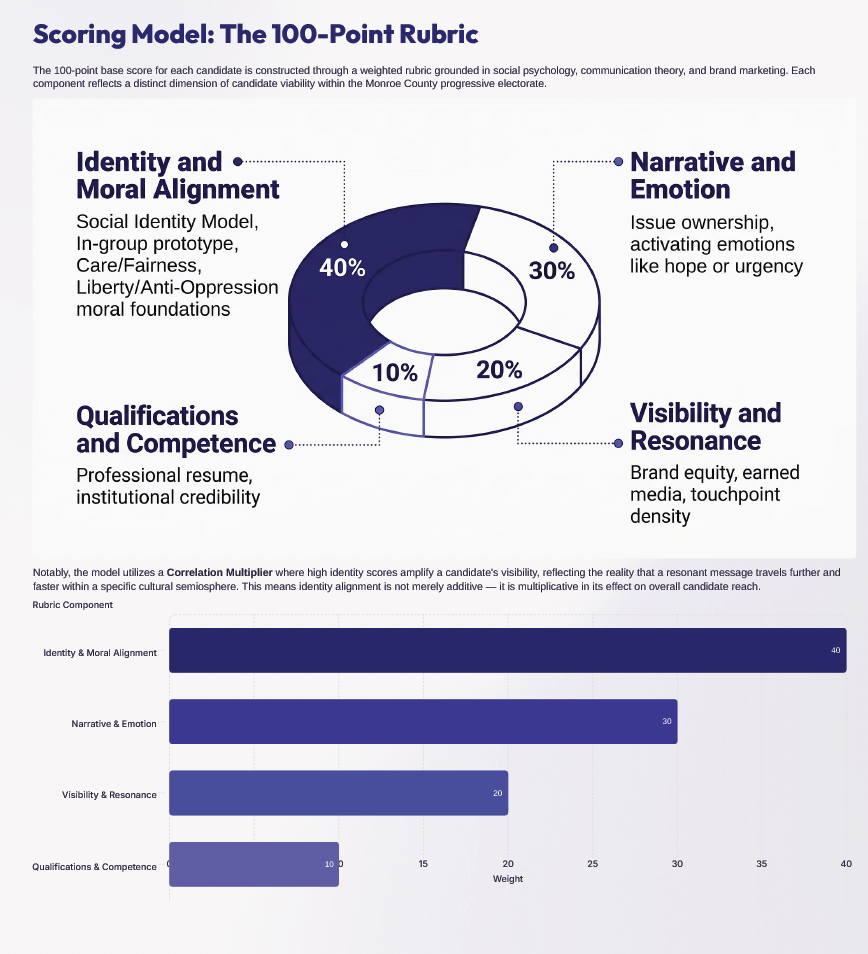
The Social Identity Paradigm At the core of our forecast is Social Identity Theory. This paradigm suggests that voters don’t just vote based on policy checklists; they vote for leaders who best embody their community’s “in-group prototype.” In Monroe County, the historical data shows that this prototype is not the temperate, quiet institutionalist. Rather, the county consistently rewards candidates who project progressive activism, moral urgency, and a willingness to push for structural reform.
However, social identity doesn’t operate in a vacuum. The model utilizes other critical variables to measure exactly howthat identity is conveyed to the public:
- Narrative and Communication: How a candidate frames issues (e.g., marijuana nonprosecution as a moral stance vs. a quiet administrative choice).
- Brand Equity & Visibility: How effectively a candidate’s core message cuts through the noise compared to the incumbent’s built-in institutional reach.
Because Arrington’s clear, reform-oriented messaging tightly aligns with Monroe County’s progressive identity, he effectively neutralizes the traditional advantages of incumbency.
Neutralizing Bias with AI To ensure this forecast wasn’t swayed by wishful thinking or standard political assumptions, the entire architecture was insulated against human bias. Advanced AI modeling was utilized to execute an objective, deep-search data collection process (scanning over 1,400 local data points) and to rigorously score the underlying variables. This ensures the analysis is grounded in durable political science rather than partisan intuition.
Factoring in the Unknown: Volatility and Uncertainty We are operating in a high-variance environment. To account for this, the model doesn’t just spit out a single definitive number. It runs thousands of randomized simulations (Monte Carlo) that intentionally inject 10% more systemic volatility (rapid shifts in the electorate) and uncertainty (the inherent blind spots of having no local polling).
Even when we purposefully introduce this chaos to stress-test the race, Arrington’s structural advantages hold up. The baseline model secures him that 52.8% win probability, a number that acts as a floor and scales upward aggressively if progressive turnout surges above the norm.
The Bottom Line No model is a crystal ball. There are highly impactful variables that remain strictly unknown and unmodeled—most notably, the physical strength of either campaign’s canvassing operations, relational organizing, and paid advertising footprint. Ground game still matters immensely.
However, based strictly on the modeled variables of identity alignment, narrative strength, and public visibility, the data tells a clear story: Benjamin Arrington currently holds the mathematical edge to win the primary.
Leave a Reply